

Highlights from
FY 2025: Annual Report
Risk and Resilience
As extreme weather presents challenges for people and ecosystems, what can public- and private-sector leaders do now to reduce risk, increase resiliency, and maximize nature’s benefits for communities? How can we finance, evaluate, and improve those efforts? Nicholas Institute experts are working on these questions.
Highlight
Duke Experts Offer Resources for Activating Nature
Launched by the Nicholas Institute in January 2025, the Nature Activation Hub brings together tools, guidance, and research to help decision-makers integrate nature’s benefits into their work. The hub team focuses on areas like natural resources management, implementation and financing of nature-based solutions, and improving evidence and access to nature data.
Led by Lydia Olander, the hub collaborates with Duke faculty, federal and state agencies, nongovernmental organizations, and various networks to identify opportunities for and overcome barriers to scaling up nature-based solutions across the United States.

Increasingly, decision-makers and practitioners in the public and private sectors are realizing they can enlist nature to address daunting environmental and societal challenges. The Nature Activation Hub offers credible information, examples and resources to help them identify opportunities to scale up nature-based solutions.


Atlantic Conservation Coalition Dashboard
Explore a public-facing dashboard for tracking and reporting of project benefits for the Atlantic Conservation Coalition.
Highlight
Tracking Nature-Based Projects in the Mid-Atlantic
The Atlantic Conservation Coalition, a joint project of four mid-Atlantic states, The Nature Conservancy, and Duke University, received a $421 million federal grant from the U.S. Environmental Protection Agency to further its work on nature-based solutions. The grant—the largest in EPA history—will fund nature-based projects reducing carbon emissions and restoring over 200,000 acres of coastal habitats, forests, and farmland. The Nicholas Institute developed a public dashboard, launched in June 2025, to track the progress of these projects. Experts at the Nicholas Institute’s Nature Activation Hub will also aid the coalition’s efforts by assisting North Carolina State Parks and the North Carolina Coastal Federation in prioritizing projects related to state park land acquisitions and coastal habitat resilience.
dollars for natural climate solutions
Highlight
Advancing Nature-Based Solutions
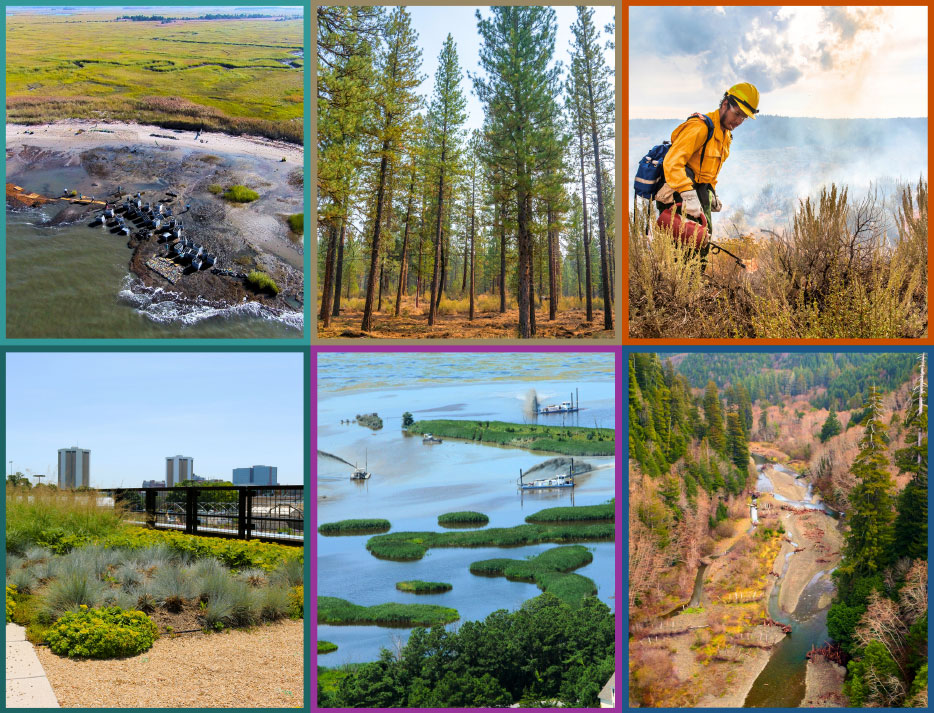
Across the United States, the public and private sectors are increasingly turning to nature-based solutions—actions to protect, sustainably manage, or restore natural or modified ecosystems to address societal challenges. The Nature Activation Hub worked with Duke faculty and external partners on a variety of projects to advance nature-based solutions over the last year.
Building On the Nature-Based Solutions Roadmap
The Nicholas Institute collaborated with the Department of the Interior to develop this comprehensive online resource to help integrate nature-based solutions into the department’s work and serve as a resource for others aiming to do the same. In FY 2025, the Nicholas Insittute enriched the original PDF resource with a searchable database of more than 400 case studies and more than 200 tools and resources to help practitioners implement nature-based solutions.
Scaling Up Financing for Nature-Based Solutions
The Nature-Based Solutions Financing Working Group, led by the Nicholas Institute, is providing resources for those interested in scaling up nature-based solutions financing. The group’s work includes building a library of case studies to show how past or ongoing projects have used a variety of financial mechanisms.
Confronting Permitting Challenges for Living Shorelines
A November 2024 working paper explores how Florida, North Carolina, and Virginia have attempted to address permitting challenges for one type of nature-based solution: living shorelines.

Helene drove home that storms are getting stronger and their impacts are reaching farther. Protecting North Carolinians is going to require smart, proactive investments to protect against future threats. We can absolutely get there, but we need everyone across government, businesses, nonprofits, academia, and philanthropy to collaborate in new and creative ways.
Highlight
Addressing Climate Hazards
Duke experts are creating new resources and developing partnerships aimed at building stronger and safer communities by reducing and managing risks from increasingly frequent natural disasters.
Center for Innovation in Risk, Catastrophes, and Decisions (CIRCAD)
In FY 2025, with support from a National Science Foundation planning grant, Duke University researchers have been working with the University of Georgia, and partners in the insurance, finance, and risk management industries to build the groundwork for CIRCAD. In fall 2025, NSF named CIRCAD as an Industry–University Cooperative Research Center, funding it to serve as a hub for catastrophe modeling, decision science, and insurance analytics, accelerating the development of tools and strategies to address escalating climate and disaster risks. The center is directed by Mark Borsuk, professor at the Pratt School of Engineering, with several other Duke experts in leadership roles, including the Nicholas Institute’s Lydia Olander.
Risk Analytics and Insurance Innovation
A pilot program organized by the Nicholas Institute and Pratt School of Engineering is exploring how insurance industry tools and innovations may help communities protect their people and economies from natural hazards.
Opportunities in Congress
A Nicholas Institute publication identifies federal bipartisan legislative efforts and leaders supporting climate resilience and adaptation as an indication of where opportunities lie for legislative action to help reduce risks.
Building Safer and Stronger in NC After Helene
In June, the Nicholas Institute and the NC Department of Environmental Quality convened a workshop to develop ideas for rebuilding North Carolina stronger and safer in the wake of Hurricane Helene. Representatives from public, private, and nonprofit entities discussed solutions and identified next steps that could make people and businesses across North Carolina more resilient to extreme weather events.
Education Spotlights

Student Profile: Chloe Wetzler, MEM-JD ’27
Chloe Wetzler is pursuing dual degrees from Duke Law School and the Nicholas School of the Environment. As a graduate assistant at the Nature Activation Hub, she supported a variety of projects, even serving as lead author for a working paper exploring challenges and solutions to permitting living shoreline projects.
“In my coursework, we learn about solutions to climate change and biodiversity loss—but often in the abstract. Working with the Nicholas Institute, however, made me feel like I was already making a positive impact as a student,” she said. “Furthermore, my research and writing for the Nature Activation Hub ended up being great networking opportunities because I got to collaborate with other professionals and organizations in the field.
“Overall, my assistantship at the Nicholas Institute was one of the most valuable experiences I have had at Duke.”

Student Profile: Sujay Dhanagare, MEM ’26
Coming to Duke with experience in finance and data analysis, Sujay Dhanagare leapt into action as a graduate assistant at the Nature Activation Hub during his first year as a master of environmental management (MEM) student. Dhanagare developed case studies to illuminate how catalytic capital is successfully raised and deployed to finance nature-based solutions and resilience projects.
“This experience directly complemented my MEM concentration in terrestrial and freshwater ecosystems, aligning perfectly with my broader interest in climate finance,” said Dhanagare. “Beyond skills, the mentorship and guidance I received from Lydia Olander and Sara Mason were invaluable, helping me make professional connections that I know will be important throughout my career.”
Supported by funding from the Nicholas Institute’s Energy Internship Program, Dhanagare was a summer intern at Azolla Ventures, an early-stage climate venture capital firm. His master’s project will involve helping Azolla move into the resilience and adaptation space, and the Nature Activation Hub will be working with the firm to develop metrics and evaluate opportunities related to hazard risk and resilience.